
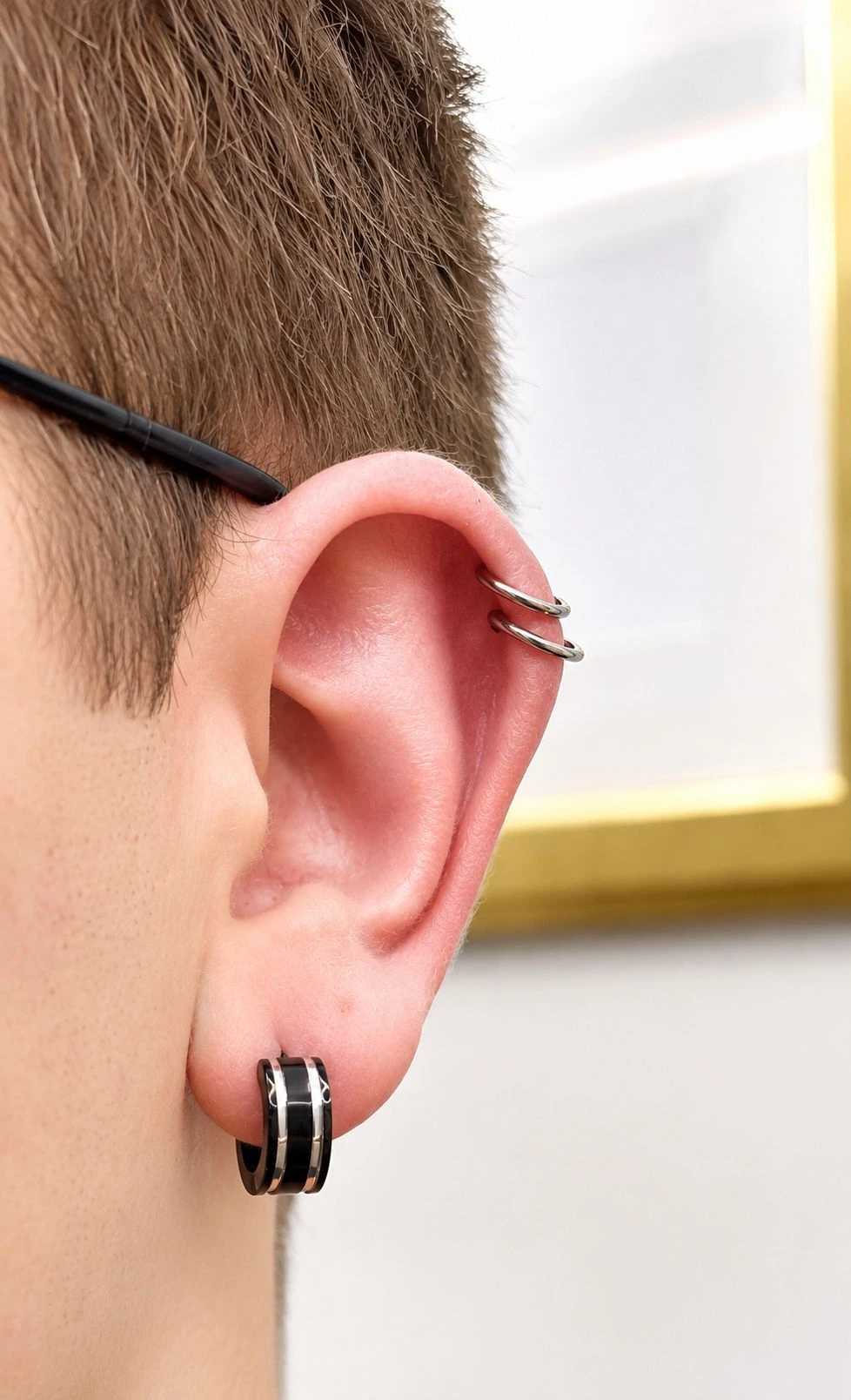
The question "when can I change my piercing?" almost always comes up sooner than is ideal for the tissue. Understandably, the initial jewelry is often more practical than aesthetically pleasing. Nevertheless, changing a fresh piercing too early is one of the most common reasons for irritation, inflammation, and prolonged healing times.
The short answer is: only when the piercing channel has healed stably or your piercer gives the go-ahead for the first change. This isn't the same for every piercing. An earlobe heals significantly faster than a cartilage piercing, a navel piercing usually slower than many think, and while the surface of lip or tongue piercings might look calm early on, the tissue inside is often still sensitive.
Therefore, it's important to distinguish between "looks good" and "is truly healed." No longer seeing redness doesn't automatically mean you can already change the jewelry yourself without issues. Especially internally, the piercing channel needs time to become stable.
Every body heals differently. Sleep, stress, smoking, friction from clothing, sports, aftercare mistakes, and the specific body part all play a significant role. Therefore, timeframes are always guidelines and not fixed promises.
For an earlobe piercing, a first change is often possible after about 6 to 8 weeks – provided the healing progresses smoothly. For a helix or other cartilage piercings, it's different: here we're talking more about several months, often 3 to 6 months or longer, until a change is truly advisable.
A nostril piercing often takes 2 to 4 months. A septum piercing can be quicker, often 6 to 8 weeks for a change, but again, only if there's no more sensitivity. Lip piercings and Medusa piercings often seem surprisingly uncomplicated at first, but you should still be cautious about changing the jewelry yourself. The first downsizing appointment with your piercer usually comes sooner, but the freedom to change jewelry at home comes later.
Patience is especially important for navel piercings. Complete healing here can take 6 to 12 months. Changing it too early risks pressure points, migration, or permanent irritation. Nipple piercings are also among the slower healers and often take many months for stable healing.
Many confuse the medically advisable first jewelry change with the point when you can change it yourself whenever you feel like it. These are two different things.
After piercing, slightly longer jewelry is often intentionally used. This allows room for swelling. Once the swelling has subsided, a professional downsizing may be advisable – meaning a shorter bar or better-fitting jewelry. This change often happens relatively early, but it's done under controlled conditions in the studio, not at home in front of a mirror.
This downsizing is particularly important for lip, tongue, or cartilage piercings. Jewelry that is too long is more likely to get caught, move unnecessarily, and irritate the tissue. However, changing to a tighter ring or a different material on your own too early is not a good idea.
If you're wondering when it's possible to change your piercing, don't just rely on the calendar. Look at your body's signals. As long as the piercing is still sensitive to pressure, weeping, crusting, feels warm, or repeatedly swells, it's usually too early for an independent change.
Even small things matter. If breathing in and out with a nose piercing still feels unusual, if a helix immediately gets irritated when you sleep on it, or if redness reappears around a navel piercing after wearing tight clothing, the piercing channel is usually not stable enough yet. In such cases, changing the jewelry rarely improves the situation.
Another point is the mobility of the jewelry. Many think a piercing is healed as soon as the jewelry can be easily rotated or pushed. This is not a reliable sign. On the contrary: unnecessary movement can delay healing.
Not only the body part, but also the jewelry type makes a difference. A straight stud or labret is often calmer during healing than a ring. Rings move more, create more tension, and cause additional irritation in many areas.
Therefore, it's important to remember: even if your piercing can generally be changed, that doesn't automatically mean every type of jewelry is immediately ideal. For example, a nostril piercing might react more sensitively to a ring than to a stud. While a fresh helix piercing might look good with a ring, it often heals much less smoothly with one.
Material is also crucial. High-quality titanium is usually a better choice for sensitive or new piercings than costume jewelry, cheap alloys, or unknown coatings. Those who cut corners often pay with irritation and extended healing time.
Impatience is a classic mistake. Next is the attempt to remove the jewelry yourself without proper tools, clean hands, or experience. What looks easy quickly turns into a struggle. The piercing channel gets irritated, the tissue swells, the new jewelry won't go in, and suddenly the partially healed piercing is injured or even almost closed.
We also frequently see jewelry that is too thin or too short being inserted. This can create pressure, constrict the area, or sit crookedly. For cartilage piercings, even a little tension is enough to cause prolonged irritation. For lip piercings, unsuitable jewelry can also unnecessarily stress teeth and gums.
Another mistake is changing jewelry immediately after sports, sauna, tanning, or a day with a lot of dirt, sweat, or friction. The tissue is often more sensitive then. It's better to choose a calm moment, a clean environment, and, if in doubt, seek professional assistance.
If your piercing is fully healed, the jewelry sits without issues, and you have experience, you can certainly change some jewelry yourself. This mainly applies to simple earlobe piercings or older, stable piercings. However, for fresh, sensitive, or hard-to-reach areas, the safest option is an appointment at the studio.
This is especially true for internal threading, small attachments, tight positions, and any area where you have poor visibility or can only work with pressure. A professional change is not only more hygienic but often gentler on the tissue. And if something isn't right, it will be noticed immediately.
This peace of mind is especially valuable during the healing phase. An experienced eye can quickly tell if your piercing just looks calm or is actually ready for new jewelry.
When a change is due, everything should proceed with as little irritation as possible. Wash your hands thoroughly, use only jewelry of the correct size and good quality, and never force anything. If the old jewelry doesn't come out easily or the new one doesn't slide in smoothly, stop immediately.
Especially for new piercings, do not try multiple times. Every failed attempt irritates the piercing channel more. It's better to have it changed professionally at the studio. If necessary, they can also assess whether a downsizing or a different type of jewelry might be more appropriate before a full change.
After the change, the piercing might be a little sensitive. This is normal. However, severe redness, throbbing pain, significant swelling, or yellow-green discharge are warning signs. In that case, please do not experiment further, but have it professionally checked.
At our studio, we generally recommend having the first jewelry change and any downsizing professionally checked, especially for cartilage, nose, lip, navel, and other areas with longer healing times. This often saves time, stress, and ideally, prevents complications.
Beautiful jewelry brings joy. It brings even more joy when your piercing stays healthy and sits well long-term. If you're not entirely sure about the timing, a little patience is almost always the better decision.


