
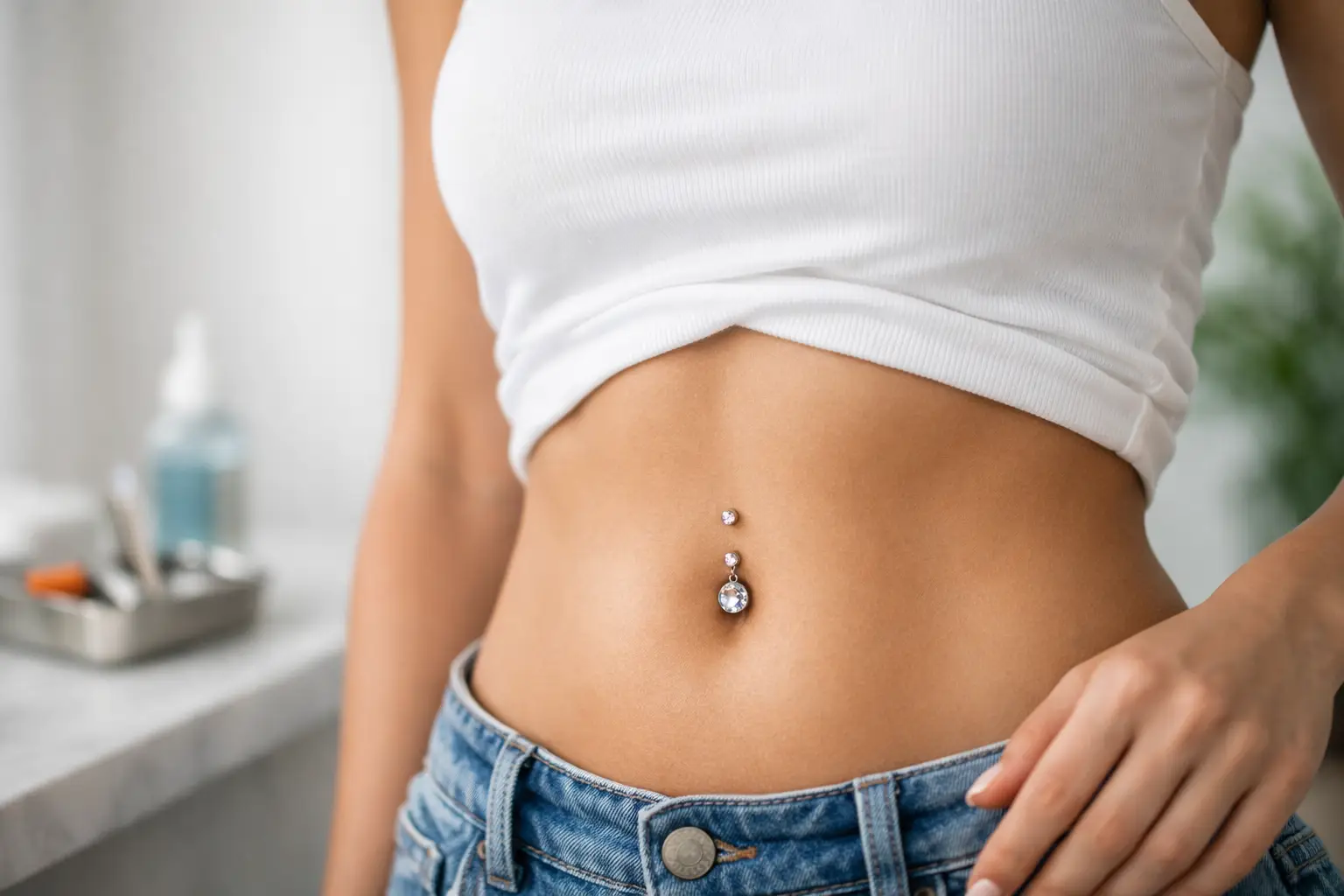
A navel piercing often looks easy and straightforward – in practice, however, a beautiful result depends not only on the jewelry but primarily on anatomy, hygiene, and proper aftercare. This is precisely where most questions arise: Does it hurt, will it heal well, and is a navel piercing even suitable for my body?
Not every navel is equally suitable for a navel piercing. That's why, at Blade & Shade, we take ample time before every piercing for a personal and honest consultation. Together, we check whether the desired spot is suitable for a navel piercing and what conditions must be met for optimal healing.
This assessment is important because a piercing that is under too much tension or is anatomically unfavorably placed can migrate faster, heal poorly, or become permanently irritated. This increases the risk of pressure points, inflammation, and scarring.
For us, professional consultation also means openly discussing potential limitations. If it turns out that a navel piercing is not the best choice, our piercers may also advise against a piercing. Our goal is always a result that not only looks good but can also heal healthily in the long term.
First, the good news: Most people find the pain brief and manageable. While the tissue around the navel is sensitive, the actual piercing itself only takes a brief moment. Many describe it more as a strong pinch followed by a feeling of warmth or pressure.
What you feel afterwards is often more relevant than the actual piercing itself. In the first few days, the area can be sensitive, especially when bending, lying on your stomach, or when clothing rubs against it. That's precisely why high-quality initial jewelry makes a big difference.
A navel piercing heals slower than many expect. While the surface often looks calm after just a few weeks, the actual healing deeper within the tissue takes significantly longer. A realistic timeframe is usually several months.
This often leads to misunderstandings. Just because a piercing is no longer red doesn't mean it's fully stable yet. Those who change the jewelry too soon, play with it, or neglect aftercare risk irritation and delays.
Careful aftercare is crucial for complication-free healing. The rule is: clean regularly, but don't unnecessarily irritate the skin. The piercing should be cleaned according to our aftercare recommendations. Avoid twisting the jewelry, moving it back and forth, or touching it with unwashed hands. This can delay the healing process and increase the risk of irritation.
During the healing phase, as little pressure as possible should be applied to the piercing. Tight clothing, high-waisted pants, or belts can irritate the fresh piercing site and impair healing. Activities involving strong friction or direct body contact should also be approached with caution in the first few weeks.
Showering is generally possible without problems. It's important to gently pat the area dry afterwards and ensure good hygiene. Less suitable in the initial period are swimming pools, hot tubs, thermal baths, or prolonged bathing. There, moisture, germs, and chemical additives can negatively affect healing.
Should any questions or uncertainties arise during the healing phase, we are always here for you. It's better to ask once too often than to jeopardize healing through avoidable mistakes.
For a freshly pierced navel, we use high-quality jewelry that provides ample space for initial swelling. Besides the appropriate size, the material plays a particularly important role. High-quality piercing jewelry is especially skin-friendly and supports uncomplicated healing.
You should avoid heavy, heavily embellished, or low-quality jewelry during the healing phase. Such jewelry can exert additional pressure, irritate the piercing site, and unnecessarily complicate the healing process. With suitable initial jewelry, you create the best conditions for a beautiful and healthily healed piercing in the long term.
Redness, slight swelling, and tenderness immediately after piercing are normal. It becomes more critical if severe pain, throbbing heat, yellowish-green discharge, or significant worsening occurs. In that case, the piercing should be professionally checked.
Another issue is what's known as rejection. This is when the tissue gradually thins, and the jewelry sits visibly shallower. This doesn't just happen by chance, but often due to unsuitable anatomy, incorrect jewelry, pressure, or chronic irritation.
Small bumps or raised areas can also occur. Not all of these are necessarily infections. Sometimes it's irritated tissue, sometimes excessive scarring. The distinction is important because the correct course of action depends on it.
Come well-rested, eat something beforehand, and wear comfortable clothing that doesn't press on your stomach. This might sound trivial, but it makes the appointment much more pleasant. If you are ill, taking medication, or prone to poor wound healing, you should discuss this openly.
A reputable studio works cleanly, explains the process clearly, and takes time for questions. This is exactly what provides reassurance – especially if it's your first piercing. At our piercing studio, this clear, personal consultation is an integral part of our service, because a good result always begins even before the actual piercing.
There are times when waiting is the better decision. If you know that a lot of friction, strenuous sports, significant weight fluctuations, or abdominal surgery are coming up soon, a later appointment might be more sensible. You should also avoid getting pierced if you have problematic skin around the navel.
Sometimes, the most honest recommendation is to forgo a navel piercing. This isn't a rejection of your wish, but a sign of professionalism. Good studios don't just say yes – they say yes when the conditions are right.
If you want a navel piercing, one thing above all is worthwhile: a thorough anatomical assessment, high-quality jewelry, and aftercare without experimentation. Then the chances significantly increase that your piercing will not only look good on the first day but will also be healed smoothly and beautifully months later.


