
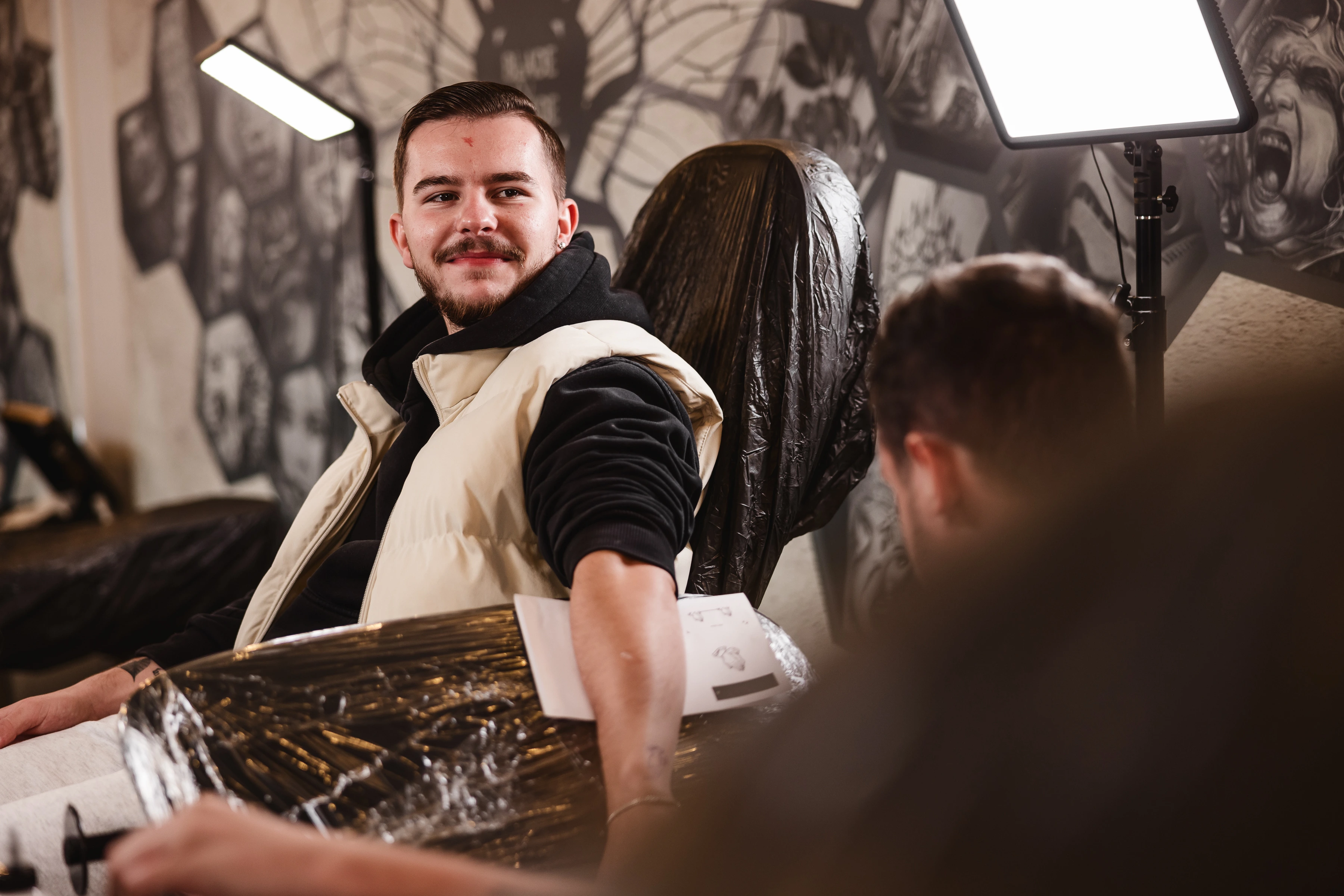
Anyone looking to remove a tattoo or have it lightened for a cover-up often asks this very question first: How many laser sessions does it actually take? The honest answer isn't spectacular, but it's important: It depends on several factors. That's precisely why professional consultation is worthwhile, rather than relying on general figures.
In practice, many treatments range between 6 and 12 sessions. However, this is not a fixed promise. Some small, older, and already slightly faded tattoos respond significantly faster to the laser. Other designs require more time, especially if they are densely inked, multi-colored, or have been reworked multiple times.
If you don't want to completely remove your tattoo but only lighten it for a cover-up, you often need fewer sessions. Often, 2 to 5 treatments are enough for a new design to be properly planned and tattooed. Here too, the goal plays a crucial role. Complete removal is different from targeted lightening.
Tattoo removal does not follow a fixed pattern. The laser breaks down the color pigments into tiny particles, allowing your body to gradually break them down. How quickly this works depends not only on the laser but also on your tattoo and your metabolism.
Black ink is generally the easiest to remove. Dark blue and other dark shades often respond well to treatment too. Lighter colors like green, turquoise, yellow, or certain red tones can be more challenging. The more different pigments your tattoo contains, the harder it is to predict the outcome.
Professionally tattooed designs usually contain more and deeper-set ink than older amateur work. This doesn't mean they are harder to remove, but treatment often takes longer. If a design has been re-inked or reworked multiple times, the effort increases further.
Older tattoos are often already somewhat faded. This can be an advantage because your body has already broken down some of the pigments. Newer tattoos usually appear richer and more compact, which can require more sessions.
The body region also plays an important role. Tattoos on well-vascularized areas often respond better than designs on hands, feet, or lower legs. There, the body works slower, and precisely this natural breakdown process is crucial for treatment success.
Every skin reacts differently. A healthy metabolism, good skin regeneration, and consistent aftercare can positively influence the process. Smoking, strong sun exposure, or impatient treatment planning, however, often unnecessarily prolong the process.
This distinction is particularly important for planning. Black tattoos often require fewer sessions than colored designs. For a small black lettering, the number is frequently on the lower end. However, for a large, colorful upper arm tattoo with multiple layers of ink, the reality is usually quite different.
Another crucial factor is how evenly the ink was applied. A tattoo that appears simple at first glance can actually be very densely pigmented. Conversely, a larger design can lighten faster despite its size if the ink is less saturated.
That's why any reputable estimate is individual. A number given without considering the specific tattoo, skin type, and desired outcome is at best a rough guess and at worst misleading.
Many people believe that more frequent appointments would make the tattoo disappear faster. While that sounds logical, it's usually incorrect. Between two sessions, your skin needs time to regenerate, and your body requires time to remove the fragmented pigments.
Intervals of about 6 to 8 weeks are common, sometimes even longer. For some individuals, 8 to 10 weeks are more sensible, especially if their skin reacts more strongly or if a gentle approach is deliberately taken. Getting laser treatment again too soon risks not only unnecessary stress on the skin but often also creates less favorable conditions for the next treatment.
When it comes to tattoo removal, patience is not an annoying afterthought, but a crucial component for achieving a clean result.
The first treatment is rarely a complete game-changer. Often, a reaction is already visible, but sometimes only a slight lightening. This is completely normal. Tattoo removal is a process, not a before-and-after result achieved in a single appointment.
Immediately after the session, your skin may be red, sensitive, or slightly swollen. This usually subsides in the days that follow. The actual visible change often develops gradually over several weeks, so you shouldn't judge the success too early.
There are cases where a tattoo remains stubborn despite good conditions. This particularly applies to cover-ups, re-inked designs, or tattoos with unknown ink mixtures. Cosmetic pigments or certain special inks can also be more challenging than classic tattoo ink.
What's important then is honest guidance instead of unrealistic promises. Not every area lightens at the same pace, and not every tattoo disappears with exactly the same quality. Reputable studios openly address these differences. This builds trust and protects against false expectations.
This question often saves time, money, and unnecessary sessions. If you don't want to completely remove your old tattoo, but rather make space for a new design , you usually need significantly fewer treatments. A targeted lightening is often enough to allow your tattoo artist to work more cleanly and plan more creatively.
Especially for cover-up projects, the synergy between laser treatment and a new design is highly beneficial. When consultation, laser planning, and the tattoo concept are considered together, a better result often emerges. For many people, this is a more sensible approach than complete removal at any cost.
The cost doesn't just depend on the price per session, but on the entire treatment duration. That's why you should never view tattoo removal solely as a single price. A seemingly cheap session is of little use if the treatment is imprecisely planned or results in an unnecessarily high number of sessions.
A sensible assessment takes into account size, amount of ink, body location, and your goal. Those who only look at the cheapest price often save in the wrong place. Ultimately, it's not just about removing the ink, but about treating your skin as gently as possible.
If someone promises you an exact number of sessions before even looking at your tattoo, you should be skeptical. Good advice is based on experience but also clearly explains the uncertainties. You'll learn what's realistic, how your skin might react, and why the intervals between sessions are so important.
Sometimes lightening is the better solution. Sometimes patience is needed. And sometimes the desired goal is achievable, but with more effort than originally anticipated. These kinds of honest conversations ultimately make all the difference.
You can support the process, even if the number of sessions cannot be fully controlled. Good aftercare, consistent sun protection, and adhering to the recommended breaks help your skin regenerate optimally. Scratching, premature strain, or impatient after-treatment, however, offer no advantage.
Equally important is a clearly defined goal before starting. Do you want to completely remove your tattoo? Just lighten it? Or are you already planning a cover-up? The clearer this direction is from the outset, the better the treatment can be planned.
An experienced studio looks not just at the tattoo, but at the whole picture. That's precisely the difference between a quick answer and truly good advice.
If you're wondering how many sessions your tattoo actually needs, the most honest answer is usually also the best: First look, then assess. At Blade & Shade in Lucerne , this individual consultation is part of the service. This way, you don't get an arbitrary number, but a realistic plan for your skin, your tattoo, and your personal goal. Ultimately, what matters is not how quickly something is promised, but how professionally and carefully the journey there is guided.


