
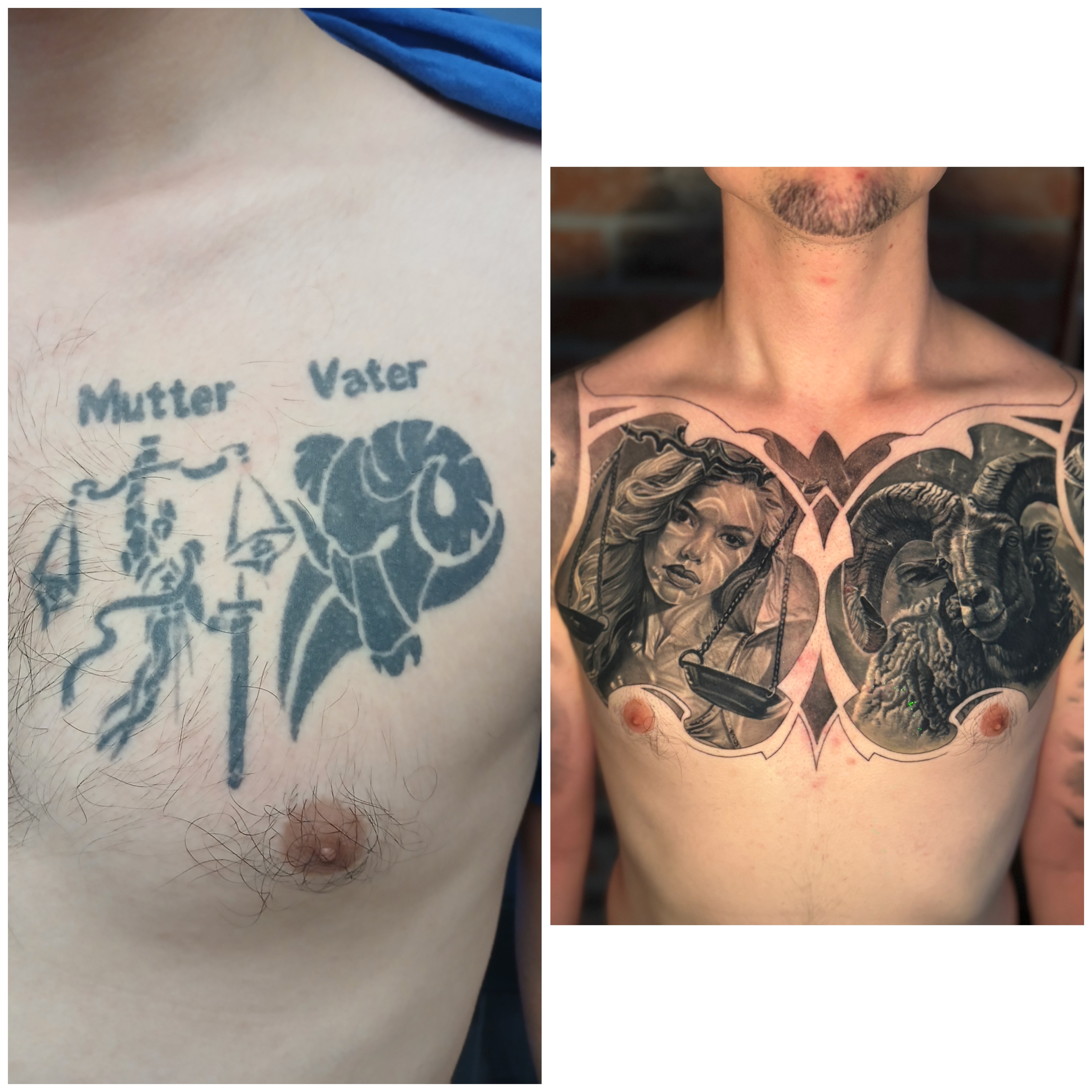
A small symbol from your teenage years, a faded name or a design that simply no longer feels like you: an unwanted tattoo does not always have to be removed. The best cover-up ideas can transform an old tattoo into a new, personal piece of art. The key is choosing a design, placement and technique that work realistically with the tattoo you already have.
A cover-up is not simply a new design placed on top of an old tattoo. It is a creative process with certain limitations. The existing lines, colours, scar tissue and size of your tattoo all influence what is possible. That is why it is worth speaking to an artist who specialises in cover-ups early on, rather than simply searching for a design you like.
Not every idea fits every old tattoo. The deciding factors are not just your taste and current trends, but also the question: which shapes and dark areas need to be integrated?
Flowers, leaves, and organic ornaments are among the most versatile cover-up solutions. They are particularly well-suited for names, dates, fine lettering, or small symbols. Petals, shadows, and leaf structures create natural areas where old lines can disappear without making the new tattoo look heavy or blocky.
Roses, peonies, lilies, or wildflowers can be executed in many different ways, from delicate and feminine to dark, graphic, and expressive. For elongated lettering, a floral motif can also be built up well along the existing shape. It is important that the flower is not simply placed in the center. The composition must consciously incorporate the old flow.
For larger or already heavily blacked-out motifs, animals, forest scenes, mountains, waves, or botanical compositions are often a strong choice. Fur, feathers, scales, shadows, and backgrounds offer enough texture to purposefully incorporate old areas.
A raven, panther, wolf, or snake, for example, can effectively carry dark areas. If you prefer something less figurative, you can work with a forest motif, a mountain landscape, or dark waves. The advantage: the cover-up doesn't look like a backup plan, but like a deliberately designed, powerful tattoo.
If your old tattoo is very dark, large, or cluttered, blackwork can be the most honest and visually striking solution. This involves creating geometric shapes, abstract areas, ornamental patterns, or graphic compositions with deliberately placed black ink.
Blackwork doesn't have to mean that the entire area becomes completely black. Negative space, lines, patterns, and skin areas create contrast and lightness. Nevertheless, this style is a clear decision. It suits you particularly well if you like a bold statement and accept that a strong cover-up will usually be more prominent than the original tattoo.
Realistic tattoos can be very effective for cover-ups if your existing motif is suitable for them. Portraits of animals, dark roses, statues, clocks, clouds, or detailed landscapes work with light and shadow. This allows you to place old contours in dark zones and draw the eye to new details.
Here, the choice of artist is particularly important. Realistic cover-ups require not only technical skill in the style itself but also experience in anticipating existing lines and pigments. A beautiful reference image alone is not enough. The design must be reconceived for your skin and your existing tattoo.
Geometric patterns, Mandalas and ornaments can work well if your old tattoo is central, symmetrical, or relatively compact. They bring order to cluttered areas and can be adapted to arms, shoulders, the back, or thighs.
The challenge lies in the precision. A mandala must be carefully planned so that it doesn't just cover something up, but looks calm and balanced on your body. For very dark old tattoos, additional shading or larger ornamental elements are usually required. Pure fineline is rarely sufficient as a cover-up.
Sometimes the best cover-up idea isn't a new tattoo right away, but rather targeted lighteningfirst. Especially with very dark, densely tattooed, or poorly placed motifs, laser treatment can significantly expand your creative options.
It is not always about complete tattoo removal. Just a few sessions can reduce pigment, allowing for finer lines, lighter areas, or a smaller new motif afterward. If you want to cover a dark tribal, thick lettering, or an old color tattoo, this preparation often gives you more options and a more harmonious result.
Lightening can be useful depending on the color, depth, age, and condition of your tattoo. A reputable consultation will not hide the fact if a direct cover-up would be too dark, too large, or creatively limited. It is precisely this honesty that protects you from a result that you won't be happy with later on.
The best cover-up doesn't just make your old tattoo disappear; it uses shape, contrast, and movement so skillfully that the old motif no longer plays a role. This usually requires more surface area, stronger contrasts, and a well-thought-out composition than a tattoo on untouched skin.
A common misconception is: "I'll just put a light motif over it." Light colors and very fine lines generally cannot reliably cover a dark, old tattoo. Black, dark blue, and bold red, in particular, remain visible under transparent colors. A cover-up therefore often works better with darker areas, shading, textures, and clear focal points.
Your skin itself also deserves attention. If your old tattoo was tattooed very deeply, healed unevenly, or is scarred, even more careful planning is required. This doesn't mean a cover-up is impossible. It means that experience and a realistic consultation are crucial.
The biggest mistake is wanting to keep a cover-up as small as possible. To ensure your old tattoo reliably fades into the background, the new motif often needs to be larger. This isn't a sales tactic, but a matter of contrast, opacity, and design.
Also problematic are motifs you choose only because of a current trend. A cover-up is meant to replace a tattoo you no longer want to see. Therefore, take your time to find an idea that will suit you in the long term. Don't just ask yourself what will cover your old tattoo, but also what you would like to wear on your skin in the future.
Also, avoid comparing your situation to photos of cover-ups on completely different skin. Every starting tattoo is different. A small gray symbol cannot be covered with the same methods as a solid black piece of lettering. Good artists won't promise you miracles, but will clearly explain which solution is realistic for your starting point.
For a well-founded assessment, the artist needs good photos of your tattoo in natural light, as well as information about its age, colors, any scarring, and the direction you would like to go. During the conversation, we will clarify which elements need to be covered, how large the new tattoo should be, and which style offers the best conditions.
After that, we don't just create a random motif from a catalog, but an individual design. At Blade & Shade in Lucerne, your request is assigned to the artist whose style and cover-up experience match your project. Our large team allows for different approaches, from floral compositions and realism to graphic and blackwork.
Plan for plenty of time. Larger cover-ups often require multiple sessions to ensure that details, contrast, and the healing process are handled properly. The goal isn't just to cover something up, but to create a design that feels like a natural part of your skin.
A great cover-up starts with an honest assessment and ends with a design you’ll never want to hide again. Bring your ideas, photos of your existing tattoo, and even your concerns to your consultation. The right artist will turn them into a plan that fits you aesthetically, technically, and personally. If you are looking for a great tattoo studio for cover-up tattoos, you’ve come to the right place. Book your free, no-obligation initial consultation with us.


