
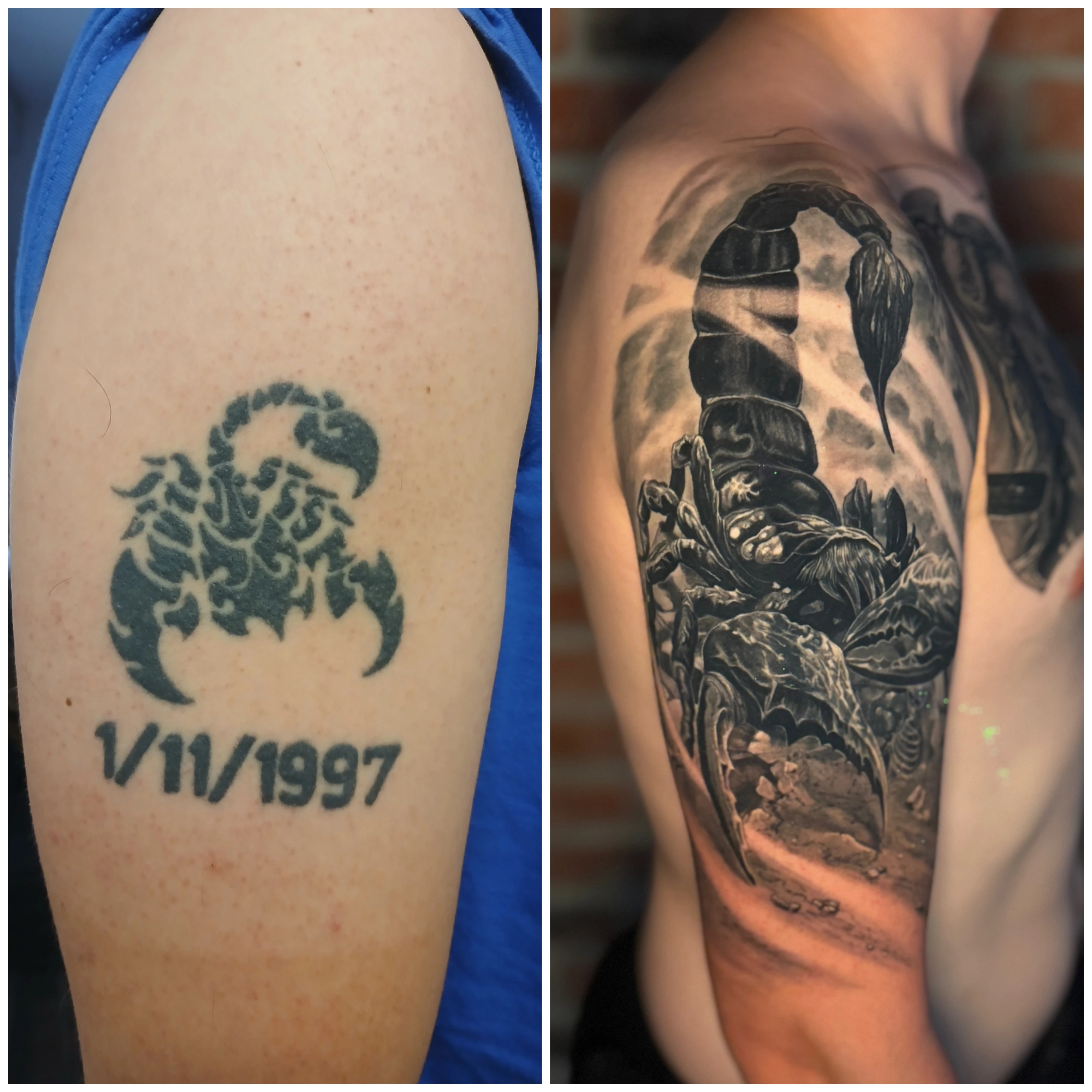
A cover-up rarely fails due to the idea itself. More often, it fails because the old tattoo is too dark, too dense, or too high-contrast. This is precisely why lightening a tattoo for a cover-up is so crucial. If you want a truly cohesive new design, you shouldn't just think about covering it up, but first determine how much preparatory work is needed.
Many clients come to us wanting a complete fresh start, and in many cases, it's perfectly sufficient to selectively lighten the existing tattoo so that a cover-up can be designed more cleanly, more finely, and with much greater freedom. It's crucial that laser treatment and tattoo design are considered together from the outset.
When lightening a tattoo, the old tattoo isn't necessarily completely removed. The goal is to reduce the pigments enough so that the existing design no longer dominates the new one. How much lighter the tattoo needs to become depends on the planned cover-up.
A black, compact tribal usually requires different preparation than a faded lettering or a small color tattoo. Black often responds well to laser treatments, while individual colors can be significantly more challenging depending on the pigment. Therefore, there's no blanket statement like: two sessions are always enough. You need to assess the existing tattoo, its color density, the skin, and the desired new work together.
The interval between sessions is also important. The body doesn't break down fragmented pigments overnight. Those who try to rush the process risk unnecessary skin stress rather than a better result. Good planning is clearly more valuable than speed here.
This is precisely where many wrong decisions are made. Those who only ask how quickly something can be lightened miss the more important question: How much lightening does this tattoo need for the new design to truly work?
For a cover-up, a tattoo often doesn't need to be completely removed. This is a relief for many, as it often keeps the effort, time, and costs more manageable. At the same time, you shouldn't stop too early just because the design already looks a bit lighter.
The crucial factor is whether the future artist can truly work with that foundation. A slight lightening that looks good in photos might still be insufficient in practice. That's why coordination between laser treatment and the cover-up tattoo is always worthwhile. We'd be happy to advise you on this at our tattoo studio in Lucerne. Our tattoo artists work hand-in-hand with our laser experts.
Black or dark grey tattoos with clearly defined areas are particularly good candidates. Here, you can selectively create lightness without necessarily treating the entire design. Old, already somewhat faded tattoos are also often grateful candidates.
It becomes a bit more complex with very colorful tattoos, dense shading over a large area, or designs that have been re-inked multiple times. This doesn't mean a cover-up is impossible. It just means that planning and expectations need to be more realistic.
Scar tissue can also play a role. If a tattoo is heavily scarred or overworked, the skin sometimes reacts differently to laser treatment and later to new tattooing. In such cases, a particularly precise assessment is needed to ensure the final result is truly satisfactory.
The process always begins with an assessment of the existing tattoo and the desired design. This involves not just size and color, but also style, skin condition, and personal expectations. Sometimes, during the consultation, it becomes clear that a direct cover-up is possible. In other cases, a few laser sessions are a much better solution.
After each treatment, the skin needs time to regenerate. This healing phase isn't an annoyance; it's crucial. Only once the skin has fully healed and we can see how much the design has faded can the next step be planned effectively.
Even before the actual cover-up, you shouldn't rush the process. The skin needs to be ready to be tattooed again. Rushing this stage unnecessarily jeopardizes the quality of the new tattoo.
Not every desired design works for every old tattoo. The more flexible you are with shape, contrast, and style, the better the possibilities usually are. Sometimes, a slight lightening is enough to open up significantly more design options.
It's also important to be willing to trust the process. A great cover-up rarely happens with quick fixes. Good decisions require clear advice, realistic assessment, and a team that doesn't treat laser removal and tattooing as separate issues.
Many people think that a tattoo needs to be removed as completely as possible before a cover-up. In practice, however, lightening isn't about maximum removal, but about targeted skin preparation. The existing tattoo is reduced just enough so that the new design can be cleanly applied. The goal isn't completely blank skin, but an optimal foundation for the cover-up.
Similarly, the misconception persists that any design is possible after laser treatment. Even a lightened tattoo still sets certain limits for the new design. Especially very dark, large, or awkwardly placed tattoos still need to be factored into the cover-up. A good result, therefore, comes not just from lightening, but primarily from a well-thought-out new design.
The idea that a larger cover-up automatically works better is also incorrect. While more surface area often provides more options, without proper preparation, the new tattoo can quickly become unnecessarily dark and heavy. The best results usually come from a combination of targeted lightening, a suitable design, and clean execution.
Lightening is especially beneficial for those who want a high-quality cover-up without making too many compromises on the new design. If you don't just want to get something tattooed over it, but a tattoo that truly suits you, preparation is often the crucial step.
In daily studio practice, it's consistently shown that the best cover-ups don't come from rushing, but from good planning. At Blade & Shade, we therefore carefully assess what's technically possible and what truly makes sense artistically. This often saves frustration, unnecessary sessions, and a result that's only halfway satisfying.
If you no longer want to see an old tattoo, you don't automatically have to have it completely removed. Sometimes, it's enough to lighten it just enough to turn a problem into a real design opportunity.


